The Mineral
What is aragonite?
Aragonite is a mineral form of calcium carbonate, CaCO₃, and one of the two crystal polymorphs that calcium carbonate takes at the Earth's surface. Here is what the mineral is, how it differs from calcite, and why the oolitic aragonite of the Bahama Banks is a thing apart.
The basics
Aragonite is a calcium carbonate mineral
Aragonite is a carbonate mineral with the chemical formula CaCO3, written properly as CaCO₃. One calcium atom, one carbon atom, three oxygen atoms. It is the same compound you find in limestone, chalk, marble, seashells, and coral reefs. Chemically, aragonite is nothing exotic. It is calcium carbonate.
The chemistry is ordinary. The architecture is what sets aragonite apart. Calcium carbonate can crystallize into more than one arrangement, and aragonite is the orthorhombic one, grown as long slender needles rather than the blocky rhombs of its more familiar relative, calcite. Same formula. Different crystal. That distinction is the whole subject of the next section.
You have almost certainly held aragonite without knowing it. It is the mineral of mother-of-pearl and of the nacre that lines a mollusk shell, and it is what reef-building corals lay down as skeleton. It also precipitates straight out of seawater with no help from anything living, wherever warm, shallow, calcium-rich water is kept moving by tide and current. That inorganic route is the one that concerns us here. It is how the aragonite sand of the Bahamas gets made.
Polymorphs
Aragonite vs calcite
Calcium carbonate has two common crystal forms at the Earth's surface: aragonite and calcite. Mineralogists call them polymorphs, meaning identical in composition and different in crystal structure. Both are CaCO₃. Neither is a variety of the other, and neither is a mixture of anything.
Calcite is the trigonal form, and at ordinary surface temperature and pressure it is the stable one. Aragonite is the orthorhombic form, denser and marginally harder, and the more soluble and less stable of the two. Left alone across geological time, aragonite recrystallizes into calcite. That is why aragonite is common in young marine sediment and scarce in ancient rock, and why limestone, a calcite rock, is what remains after a few hundred million years.
| Property | Aragonite | Calcite |
|---|---|---|
| Formula | CaCO₃ | CaCO₃ |
| Crystal system | Orthorhombic | Trigonal |
| Crystal habit | Needles | Rhombs |
| Mohs hardness | 3.5–4 | 3 |
| Specific gravity | 2.95 | 2.71 |
| Surface stability | Metastable | Stable |
| Solubility | Higher | Lower |
Standard reference values for the two minerals. They describe the crystal and not the behavior of any particular material in any particular process.
The oolite
What makes oolitic aragonite different
Not all aragonite is oolitic. "Oolitic" describes the shape the mineral grew into, and it is the reason Bahamian aragonite behaves the way it does: a clean, rounded, free-flowing sand instead of a crushed rock.
The ooid
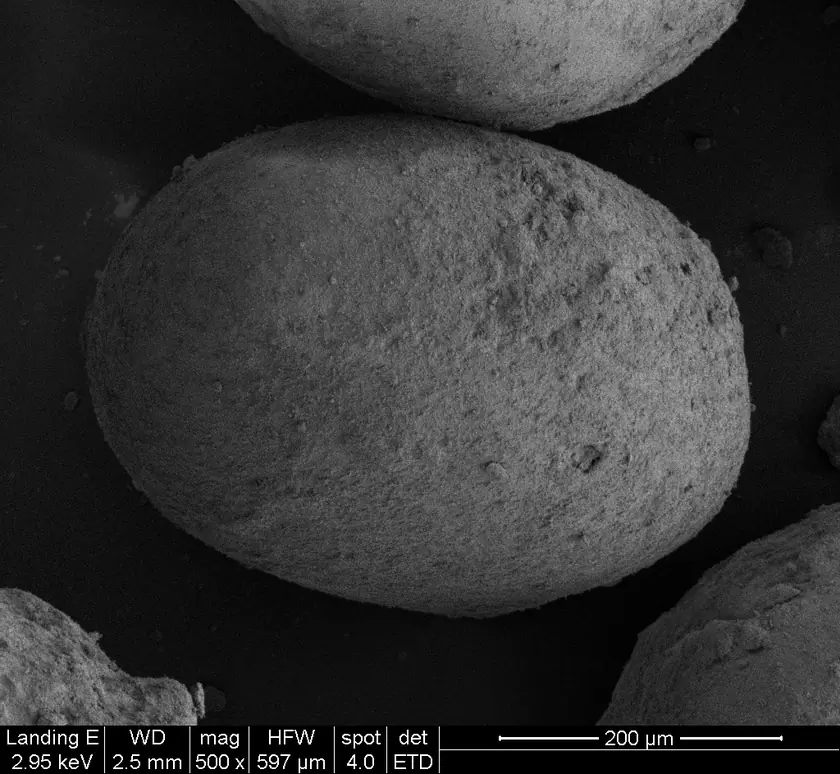
An ooid is a sand-size grain, roughly a quarter of a millimeter to two millimeters across, made of concentric layers of calcium carbonate wrapped around a tiny nucleus: a shell fragment, a grain of sand, a speck of organic matter. Every layer precipitated out of the seawater itself. A sand made of ooids is an oolite, and the adjective is oolitic.
Grown, not crushed
Bahamian oolites are a very pure calcium carbonate: ovular grains built from needle-like crystals that clump together as they precipitate to the ocean floor. A quarried carbonate gets blasted and milled, so its grains are angular fragments. An ooid was never broken. It was built, layer by layer, and it arrives rounded because that is the shape it grew into.
Constantly forming
Limestone is finite. Aragonite is still forming, in great numbers, where Atlantic waters converge with the Gulf Stream. A renewable mineral resource. It is not a deposit laid down in the deep past and drawn down ever since. It is a sand that is being made right now.
Built by biology and chemistry together
Ooid growth on the Banks is tied to the life in the water above it. Photosynthesis by marine microorganisms raises the local pH, and calcium carbonate precipitates out of the already-supersaturated seawater onto the surface of the growing grain. The mineral itself is inorganic. The conditions that build it, layer by layer, are biological.
Origin
The Bahama Banks, where aragonite forms
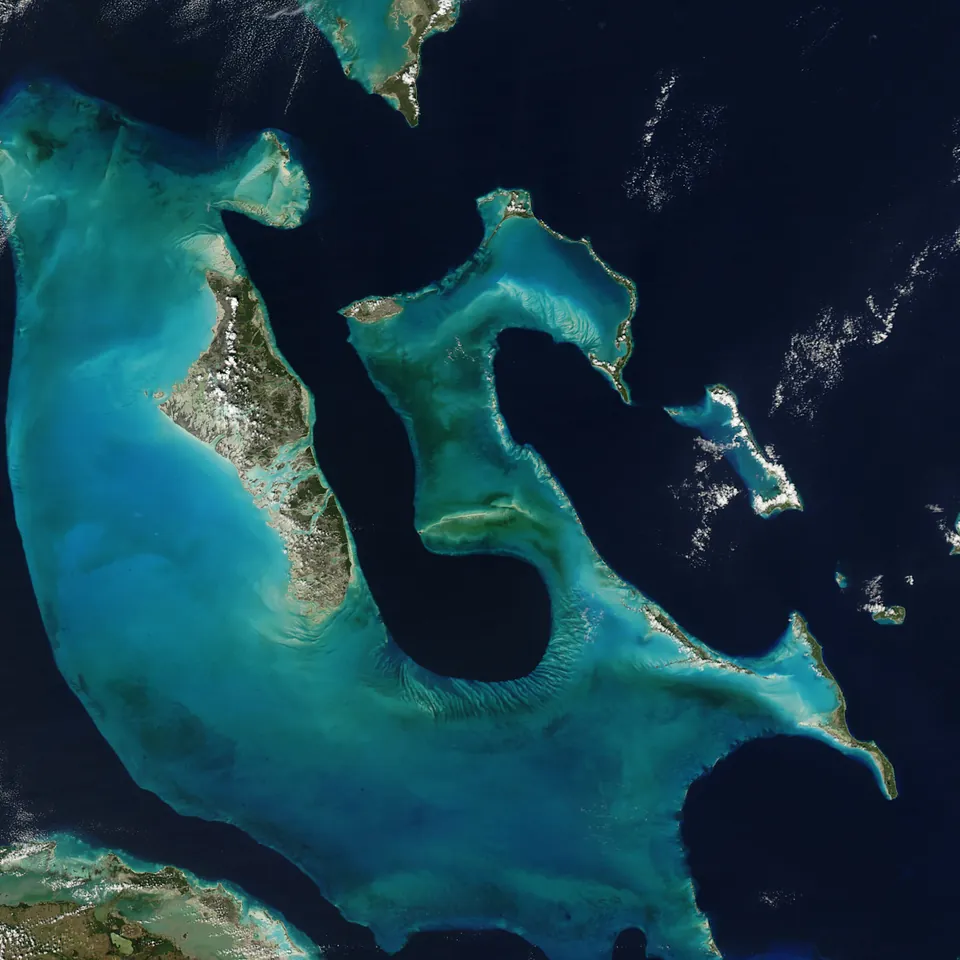
Oolitic aragonite needs four conditions at once: warm water, shallow water, water already saturated with calcium carbonate, and enough current to keep a growing grain rolling. Very few places on Earth supply all four. The Bahama Banks supply them continuously.
The banks are a vast, shallow carbonate platform, and along their western margin the Atlantic converges with the Gulf Stream. Water warms as it crosses the shallows, carbonate comes out of solution, and ooids grow, roll, and settle. That is why the Bahamian shallows read as that particular pale turquoise from the air. It is a working mineral factory, not a fossil deposit.
The former principals of Marcona run Aragonite Source. They harvested aragonite at Ocean Cay from the 1970s into the early 2000s. We dig today in close conjunction with the Bahamian government, at sites chosen for how uniformly the product tests and how well the ground renews itself.
Applications
How aragonite is used
A pure, rounded, renewable calcium carbonate turns out to be useful in a lot of places. Each one has a page of its own.
Glass manufacturing
A low-iron calcium carbonate for the glass batch.
Agriculture
A renewable calcium carbonate for soil and crop programs.
Animal nutrition
A calcium source and rumen buffer for livestock feed.
Pet food
Calcium carbonate for pet food, treat, and supplement blends.
Beach replenishment
Bright white nourishment sand, sized to match a native beach.
Play sand
A silica-free white sand for playgrounds and sandboxes.
Non-silica abrasives
A silica-free blasting media, by composition.
Environmental remediation
A high-purity carbonate for buffering and treatment work.
Ultra-fine calcium carbonate
Milled fine for cosmetics, plastics, and paints.
Let's talk supply.
Now you know the mineral. Tell us what your process needs from it, and we'll get you material that hits the spec.
Thank you. We're on it.
Your inquiry is in. We'll be in touch shortly. The email and phone above stay open if you'd rather not wait.